Confused by doodle generation labels? Learn exactly what F1, F1B, F2, and Multigen mean for coat, shedding, and predictability across Goldendoodles, Bernedoodles, Cavapoos, and Maltipoos
f you've spent any time browsing Goldendoodle, Bernedoodle, Cavapoo, or Maltipoo listings, you've probably run into a string of letters and numbers that don't mean much at first glance, F1, F1B, F2B, Multigen, and so on. These labels aren't just breeder jargon for the sake of sounding technical. They actually tell you quite a bit about what to expect from a puppy's coat, shedding, size, and even temperament. Once you understand how generations work, choosing between litters gets a lot less confusing. So let's break it down properly, one generation at a time.
Why Generations Exist in the First Place
Every doodle breed, whether it's a Goldendoodle, Bernedoodle, Cavapoo, or Maltipoo, starts the same way: crossing a Poodle with another purebred dog. But a breeder doesn't have to stop at that first cross. Puppies from that first generation can later be bred back to a Poodle, bred to another doodle, or bred to another dog of the original non-Poodle breed. Each of these choices produces a different genetic mix, and that mix is what the generation label is describing. Think of it less as a grading system and more like a genetic recipe, each generation tells you roughly what proportion of Poodle versus the other breed is in the puppy's background.
F1: The First Generation
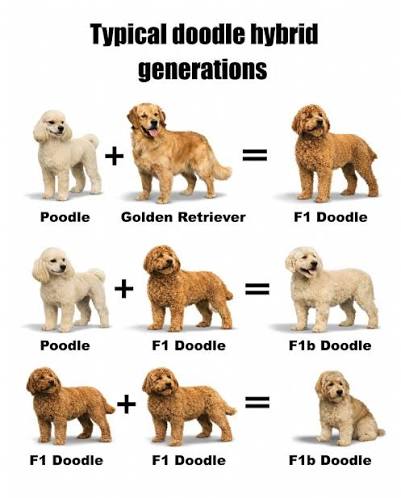
An F1 doodle is the original cross, one purebred Poodle parent and one purebred parent of the other breed (a Golden Retriever, Bernese Mountain Dog, Cavalier King Charles Spaniel, or Maltese, depending on the breed you're looking at). Genetically, an F1 puppy is 50% Poodle and 50% the other breed.
F1 puppies tend to have the most genetic variety within a single litter, since traits from two very different purebred backgrounds are combining for the first time. This means coat type can range quite a bit even among littermates, some F1 puppies come out wavier and looser, closer to the non-Poodle parent, while others show more of the Poodle's curl. F1 puppies also tend to shed a bit more than later generations, since the non-shedding trait from the Poodle isn't yet the dominant influence in the mix. On the plus side, F1 puppies often benefit strongly from what's called hybrid vigor, a general boost in health and resilience that comes from combining two genetically distinct purebred lines.
F1B: The Backcross Generation
An F1B doodle comes from breeding an F1 doodle back to a purebred Poodle. This shifts the genetic makeup to roughly 75% Poodle and 25% the other original breed. That extra dose of Poodle genetics is why F1B puppies are the generation most people mean when they picture a classic, curly, low-shedding doodle.
F1B puppies tend to have curlier, denser coats and shed noticeably less than F1 puppies, which is why this generation is often recommended for families managing allergies or sensitivities. The tradeoff is that these coats usually need more frequent brushing and professional grooming to prevent matting, since the tighter curl traps loose hair rather than shedding it out naturally the way a looser coat would.
F2: The Second Generation
An F2 doodle comes from breeding two F1 doodles together, rather than backcrossing to a Poodle or the original breed. Genetically, this still averages out to roughly 50% Poodle and 50% the other breed, similar to an F1, but because both parents are already a doodle mix rather than a purebred, F2 litters can actually show more coat and trait variation than F1 litters, not less. You might see puppies in the same F2 litter ranging from fairly straight-coated to quite curly, depending on which genes each parent happened to pass down.
F2 doodles are less commonly bred than F1 or F1B, partly because that unpredictability makes it harder for breeders to guarantee consistent traits to families with specific coat or shedding preferences.
F2B and Beyond: Multigenerational Doodles
An F2B doodle comes from breeding an F1B doodle back to a Poodle again, pushing the genetic makeup even further toward Poodle, typically somewhere around 87.5%. From here, breeders can continue combining doodle generations together or backcrossing to Poodle to create what's generally referred to as "multigenerational" or "multigen" doodles, essentially any generation beyond F2.
Multigen doodles are bred specifically for consistency. By this point in the generational chain, breeders have a much clearer picture of which traits reliably show up, curl type, shedding level, even certain color patterns, because they're working with established doodle lines rather than a fresh cross between two purebreds. This is why multigen litters tend to be the most predictable option if you have very specific preferences about coat type or shedding, though it's worth noting that "most predictable" doesn't mean "guaranteed," genetics still carries some natural variation no matter how many generations deep you go.
Quick Comparison Chart
| Generation | Approximate Poodle % | Shedding | Coat Predictability |
|---|---|---|---|
| F1 | 50% | Low to Moderate | Lower, more variation within litter |
| F1B | 75% | Low | Higher, curlier and denser |
| F2 | 50% | Low to Moderate | Lower, can vary widely |
| F2B | 87.5% | Very Low | High |
| Multigen | 87.5%+ | Very Low | Highest, most consistent |
Does Generation Affect Temperament?
Generally, less than people expect. Temperament is shaped far more by the individual parents' personalities, early socialization, and how a puppy is raised than by generational math. That said, since later generations lean more heavily toward Poodle genetics, some families do notice slightly more of the Poodle's characteristic intelligence and trainability showing up in F1B and multigen puppies, while F1 puppies may lean a bit more toward the temperament traits of the non-Poodle parent breed. These are tendencies, not guarantees, every puppy is still very much its own individual.
Does Generation Affect Size?
Indirectly, yes, mostly through which size of Poodle was used at each stage of the cross rather than the generation label itself. A litter bred using a Toy or Miniature Poodle will trend smaller regardless of whether it's F1 or multigen, while one bred using a Standard Poodle will trend larger. If size predictability matters to you, the specific Poodle size used and the parents' actual weights matter more than the generation label alone.
Which Generation Should You Choose?
There's no universally "best" generation, it really depends on what matters most to you:
- If minimizing shedding and allergy sensitivity is your top priority, F1B or multigen is generally the safer choice
- If you're less concerned about shedding and more drawn to the classic look and slightly looser coat of an F1, that's a perfectly good option too, just expect a bit more brushing and vacuuming
- If coat consistency and predictability matter most, multigen litters tend to deliver the most reliable results
- If none of the above are dealbreakers for you, honestly, the individual puppy's personality and the health of the specific parents should weigh more heavily in your decision than the generation label
Frequently Asked Questions
Is a higher generation always "better"?
Not necessarily, it depends on your priorities. Higher generations (F1B, multigen) tend to offer lower shedding and more predictable coats, but F1 puppies benefit from stronger hybrid vigor and can still shed minimally depending on the individual dog.
Which generation is best for allergies?
F1B and multigen doodles are generally recommended for allergy-sensitive households, since they carry a higher proportion of Poodle genetics, which tends to reduce shedding and dander. That said, no dog is completely hypoallergenic, and individual reactions vary.
Do all puppies in a litter have the same generation?
Yes, generation is determined by the parents' breeding, not the individual puppy, so every puppy in a single litter shares the same generation label. However, individual traits like exact coat texture can still vary between littermates.
Can generation predict adult size accurately?
Generation alone doesn't determine size as much as which size of Poodle was used in the breeding line. Asking about the specific parents' weights gives a much more accurate size expectation than the generation label by itself.
We're always happy to walk you through the exact generation, parents, and expected traits for any of our current litters, across our Goldendoodles, Bernedoodles, Cavapoos, and Maltipoos. Take a look at our available puppies or reach out through our contact page with any questions about a specific litter.